The Biotech Rebound – and What It Means for Emerging Companies

Coming out of January’s JP Morgan Healthcare Conference, a clearer picture has started to form about where biotech is headed. After several years of tight capital and companies operating in survival mode, the biotech industry appears to be entering a more constructive phase — one defined by discipline and execution, with a growing — and still cautious — optimism that the worst of the downturn is behind us.
Public Markets Have Rebounded Sharply
Biotech public stocks have long been an important barometer of broader industry sentiment. From its trough in April 2025, the SPDR S&P Biotech ETF (XBI) has rallied dramatically. In an amazing — and under-appreciated — turnaround, the XBI has risen 98% from its lows in less than a year.
Cash-Rich Pharma Is Back in the Market for Emerging Biotech Science
Large pharmaceutical companies are sitting on substantial cash reserves and face a growing need to replenish aging pipelines. Lilly is a clear example: their metabolic franchise generates enormous cash, and they are actively directing that capital into external innovation to strengthen the pipeline.
As such, big pharma is actively hunting for new opportunities and engaging earlier with emerging biotechs. For founders, this creates a viable source of capital and support beyond traditional venture funding. For VCs, it’s a strongly positive signal that high-quality science is attracting real attention from strategic buyers and partners.
The IPO Window Is (Finally!) Opening
After a multi-year chill in public biotech financings, Boston-based Aktis Oncology’s IPO stands out as a meaningful signal for capital markets. In early January 2026, Aktis priced a roughly $318 million offering. Its shares priced at the top of the range and traded positively in initial sessions — a rare outcome in recent years.
Aktis’ IPO is one of the largest biotech listings in the past few years. In a momentum-driven industry like biotech, a small number of strong offerings can go a long way toward reopening the IPO market.
Venture Capital Has Money — and Is Re-Engaging
While VC investment has remained cautious, many firms are sitting on substantial dry powder. PitchBook reports that biotech and life science VCs are holding record levels of uninvested capital, creating growing pressure to deploy it. Large funds such as Atlas Venture, Third Rock, and ARCH have raised new pools of capital and appear increasingly ready to re-engage. More broadly, the VC community has become meaningfully more active with emerging biotechs than in recent years, with deeper diligence and a noticeable uptick in activity.
The combination of available capital and renewed engagement puts founders with strong science and well-defined milestones in a meaningfully better position than they were 12–18 months ago, even as investors remain disciplined about where they deploy capital.
AI: A Tool, Not a Panacea
One clear takeaway from JP Morgan is that expectations around AI have matured from hype — “AI is going to totally replace the lab!” — to a tool with practical applications, such as accelerating drug discovery, improving translational insight, and supporting more efficient operations.
There’s growing recognition that AI will play an important role in biotech R&D, but it isn’t a substitute for strong biology or disciplined execution. Used well, it’s an accelerant, particularly for well-known mechanisms. But it’s not a shortcut.
What This Means for Emerging Biotech Companies
These trends point to a healthier and more durable environment for biotech than we’ve seen in several years. Capital is still being deployed carefully, but it’s no longer frozen — and expectations are clearer.
For emerging companies, that clarity matters. Investors want to see defined milestones before committing capital, which puts real pressure on efficiency — every dollar needs to move the science forward and reduce risk. At the same time, founders have more ways to fund progress than they did a year or two ago. Partnerships with pharma, collaborations with AI-enabled platforms, and selective use of specialized service providers can all help extend runway and demonstrate momentum without over-building internally.
What This Means for Lab Infrastructure
Emerging biotechs are rethinking their labs. Flexible, outsourced operating models are increasingly favored over heavy, fixed infrastructure, allowing teams to stay focused on core science while keeping overhead low. Variable cost structures that can scale with progress are becoming the norm.
This is where Labshares’ capital-efficient shared laboratory model fits. By providing access to fully equipped lab space and operational support without long-term commitments, Labshares helps companies move faster, generate data, and hit milestones, all while preserving capital for the moments when it matters most.
Labshares’ Expansion at 66 Galen
Our expansion into 66 Galen is a direct response to how the biotech market is evolving. By increasing our footprint and capacity, we’re creating more room for companies to advance discovery and development without taking on unnecessary overhead. The goal is straightforward: help emerging biotechs operate efficiently, move faster, and stay focused on execution in an environment where capital discipline matters more than ever.
By Philip Borden, CEO, Labshares
Related or similar articles

What We're Seeing Across the Biotech Industry
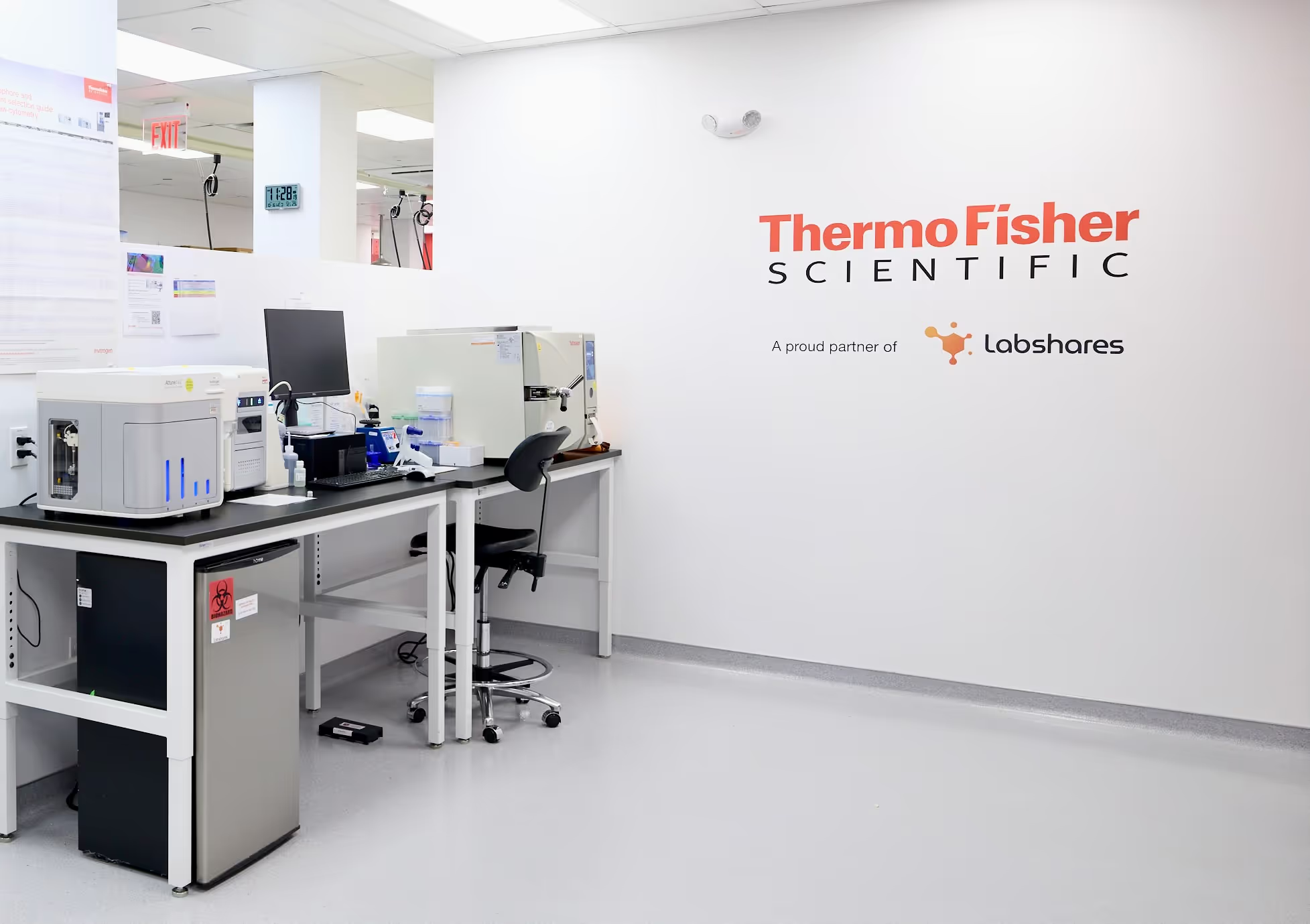
Labshares and Thermo Fisher Scientific Announce Five-Year Renewal and Expansion of Partnership